
What does the reduction ratio of a deceleration motor mean?
Release Time:
2024-11-28
In modern industry, motors are an important component that drives various equipment and machinery. As a special type of motor, the function of the deceleration motor is not only to drive, but also to adjust the speed and increase the torque. The reduction ratio, as one of the important parameters for measuring the performance of a reduction motor, is of great significance for understanding its working principle and practical applications.
In modern industry, motors are an important component that drives various equipment and machinery. As a special type of motor, the function of the deceleration motor is not only to drive, but also to adjust the speed and increase the torque. The reduction ratio, as one of the important parameters for measuring the performance of a reduction motor, is of great significance for understanding its working principle and practical applications.
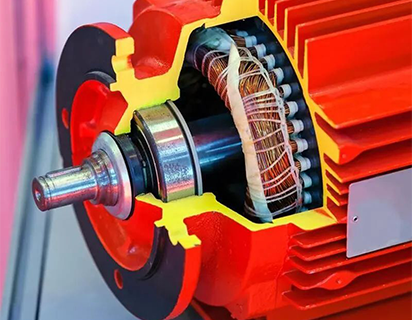
1、 Basic concept of deceleration motor
A deceleration motor is a type of motor that reduces the output speed of the motor through a reducer and increases the output torque. Its structure usually consists of two parts: an electric motor and a reducer. The electric motor drives the reducer, which reduces the speed and increases the torque through a series of gears or other transmission mechanisms. In many application scenarios, such as rail transit, automated production lines, robots, etc., deceleration motors have become key components for achieving high-performance and high-precision control.
2、 Definition of Reduction Ratio
Reduction ratio refers to the ratio of the output speed of a reduction motor to the input speed. The formula is expressed as:
Reduction ratio=input speed, output speed, reduction ratio/output speed, input speed
For example, if the input speed of the electric motor is 1500 RPM (revolutions per minute) and the output speed of the deceleration motor is 150 RPM, the reduction ratio is 10:1. This means that the speed of the electric motor is reduced to one tenth of its original speed.
3、 Calculation method of reduction ratio
In practical applications, the calculation of reduction ratio involves multiple factors, including the speed of the electric motor, the gear ratio of the reducer, and its transmission efficiency. The following are the basic steps for calculating the reduction ratio:
Determine the input speed of the motor: Verify the rated speed of the motor without considering the load.
Obtain the output speed of the reducer: Measure the actual output speed of the reducer based on the connected load and the design of the reducer.
Calculate the reduction ratio: Substitute the input speed and output speed into the above formula and perform simple numerical calculations to obtain the reduction ratio.
It is worth noting that in some complex reduction motor systems, it may be necessary to consider the combination of multiple gears or the existence of multi-stage reduction, which will make the calculation of reduction ratio more complex.
4、 The Influence of Reduction Ratio on Motor Performance
The reduction ratio has a significant impact on the performance of the reduction motor, mainly reflected in the following aspects:
Torque gain: An increase in reduction ratio usually means an increase in output torque. For example, if the reduction ratio is 10:1, the output torque will be 10 times the input torque, which is particularly important in applications that require high torque.
Speed regulation: A high reduction ratio enables the motor to operate stably at lower speeds. This ability is particularly critical in fields that require precise motion control, such as robotics and automated assembly.
Efficiency loss: Although high reduction ratio can increase torque, it may also lead to energy loss in certain situations, especially when the efficiency of the reducer design is poor. Therefore, when choosing a deceleration motor, multiple factors such as load, speed, and efficiency need to be considered comprehensively.
Heat generation: Increasing the reduction ratio may lead to an increase in the heat generated by the motor and reducer, and better heat dissipation measures need to be taken to ensure the safety and stability of the equipment.
Related News