
Advantages and disadvantages of worm gear reducer
Release Time:
2024-11-18
The basic structure of a worm gear reducer mainly consists of transmission components such as worm gear, shaft, bearings, housing, and accessories. It can be divided into three basic structural parts: housing, worm gear, and bearing shaft combination. The casing is the base of all components in the worm gear reducer, which supports and fixes the shaft components, ensures the correct relative position of the transmission components, and supports the load acting on the reducer. The main function of worm gear is to transmit motion and power between two intersecting shafts, while the main function of bearings and shafts is to transmit power, operate, and improve efficiency.
The basic structure of a worm gear reducer mainly consists of transmission components such as worm gear, shaft, bearings, housing, and accessories. It can be divided into three basic structural parts: housing, worm gear, and bearing shaft combination. The casing is the base of all components in the worm gear reducer, which supports and fixes the shaft components, ensures the correct relative position of the transmission components, and supports the load acting on the reducer. The main function of worm gear is to transmit motion and power between two intersecting shafts, while the main function of bearings and shafts is to transmit power, operate, and improve efficiency.
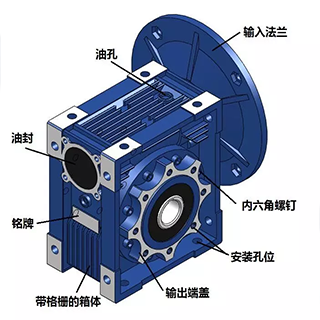
The accessories of the worm gear reducer are explained as follows:
Shell: Aluminum alloy
Worm: 20Cr steel. Carbon and nitrogen co infiltration treatment (maintaining tooth surface hardness HRC60 after precision grinding, with a hardness thickness greater than 0.5mm);
Worm gear: specially configured wear-resistant nickel bronze;
Oil cap/ventilator, mainly used to exhaust the gas inside the gearbox of the worm gear reducer;
End caps are divided into large end caps and small end caps. The end caps are used to fix the axial position of the shaft components and bear axial loads. The bearing seat holes are closed at both ends with bearing caps;
Oil seal, mainly used to prevent the leakage of lubricating oil inside the chassis and improve the service life of lubricating oil;
Oil drain plug, mainly used for draining dirty oil and cleaning when replacing lubricating oil;
Oil gauge cover/oil gauge, mainly used to observe whether the oil level inside the gearbox of the worm gear reducer meets the standard.
Advantages and disadvantages of worm gear reducer
As a traditional transmission device, the worm gear reducer has a worm gear inside, and the tooth profile is involute.
Its advantages are: long service life, low allowable input speed range, and large deceleration range. Equipped with self-locking function, it is suitable for lifting operations, such as elevators, hoists, etc., which cannot do without worm gear reducers.
Its disadvantage is that the work efficiency is too low, only reaching between 60-70%. And the worm gear is usually output through a shaft. It is difficult to control the backlash, especially when the turbine and worm have been running in for a long time, and their backlash is relatively large. Usually at the degree level.
Compared to the low efficiency of worm gears, gear reducers will occupy a larger market share in the future. In the future, gears will develop in the directions of forward heavy load, high speed, high precision, and high efficiency, and strive for small size, light weight, long service life, and economic reliability. The development of gear theory and manufacturing technology will further study the mechanism of gear tooth damage, which is the basis for establishing reliable strength calculation methods and the theoretical basis for improving gear bearing capacity and extending gear life; Develop new tooth profiles represented by circular arc tooth profiles; Research new gear materials and new manufacturing processes for gears; Study the elastic deformation, manufacturing and installation errors, and temperature field distribution of gears, perform gear tooth modification to improve the smoothness of gear operation, and increase the contact area of gear teeth under full load, thereby improving the load-bearing capacity of gears.
Related News