
The difference between servo motor and ordinary three-phase asynchronous motor
Release Time:
2024-12-03
In simple terms, after being powered on, the servo motor can control the speed and rotation angle, and achieve closed-loop precise control through encoder feedback calibration.
In simple terms, after being powered on, the servo motor can control the speed and rotation angle, and achieve closed-loop precise control through encoder feedback calibration.
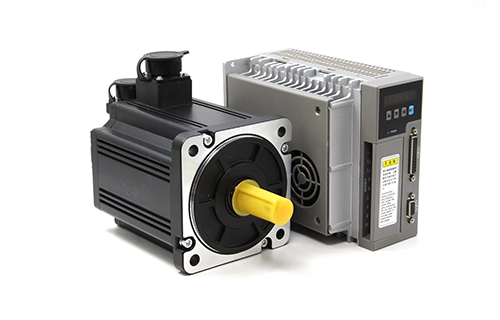
Ordinary motors, on the other hand, do not have precise control systems such as feedback loops, and start operating as soon as they are powered on. The specific differences are as follows:
Feedback method
Servo motors can achieve precise control by rotating a specified angle or number of turns at a specified speed, and the encoder measures and judges whether they are operating accurately according to the specified direction, forming a signal feedback to the controller for precise control of the servo motor.
Ordinary motors start running when powered on, without feedback and verification mechanisms, and can only achieve forward or reverse rotation through different wiring methods.
Structure and working mode
The mechanical structure of servo motors and ordinary motors is similar in principle, both consisting of a stator and a rotor. But the material, structure, and processing technology of servo motors are much higher than those of ordinary motors.
A servo motor usually consists of four parts: an encoder, a controller (also known as a driver), power cables, and a servo motor Encoders can provide feedback on position, velocity, and direction information to ensure precision control The controller is responsible for converting the control signals sent by the encoder into corresponding motor motion commands, specifying the direction of motor operation, speed, and torque The power cable is a component that connects the servo controller and servo motor, providing power and accurately delivering the required electrical energy to the motor based on control signals.
Ordinary motors only consist of the power supply part and the motor body, and the motor speed or torque can be further determined based on the magnitude of the input voltage. Normally, ordinary motors use open circuits, and their operating speed depends on the voltage, so the choice of controller is not as important as servo motors.
Repair method
The cost of servo motors is expensive, and maintenance is complex, requiring specialized equipment for machine testing and repair. Moreover, servo motors have more types of faults than ordinary motors, requiring professional electronic maintenance skills to handle issues such as signal attenuation, communication interruption, unstable speed, and pulse loss. In addition, the encoders of servo motors are all corresponding and cannot be interchanged, so it is quite troublesome.
Ordinary motors are inexpensive and easy to maintain. General motor maintenance includes machine repair, machining, welding repair, winding and other treatments.
Application scenarios
In applications such as automation, robotics, and manufacturing that require precise, high-speed, and efficient control, servo motors have more accurate position, speed, and torque control capabilities. Servo motors are a better choice, but also have higher prices and more complex control systems.
In common applications with low precision and low load, such as office equipment, household appliances, small machinery, etc., or in situations where precision is not high and cost is limited, ordinary motors can be chosen as more suitable.
Related News