
Composition and structure of three-phase asynchronous motor
Release Time:
2024-12-03
The structure of a three-phase asynchronous motor consists of a stator, rotor, and other accessories.
The structure of a three-phase asynchronous motor consists of a stator, rotor, and other accessories.
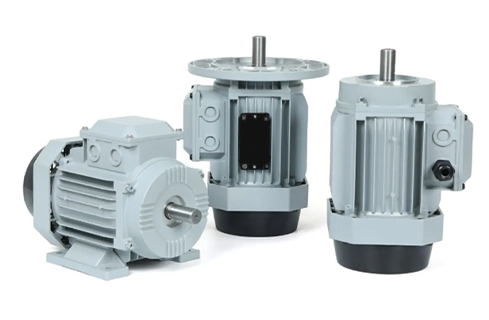
(1) Stator (stationary part)
1. Stator iron core
Function: As a part of the motor magnetic circuit, and on which the stator winding is placed.
Construction: The stator core is generally made by punching and laminating silicon steel sheets with insulation layers on the surface of 0.35-0.5 millimeters thick. There are evenly distributed slots punched in the inner circle of the core for embedding the stator winding.
There are several types of stator core slot types:
Half closed slot: The efficiency and power factor of the motor are high, but winding embedding and insulation are difficult. Generally used in small low-voltage motors.
Half open slot: capable of embedding molded windings, generally used for large and medium-sized low-voltage motors. The so-called formed winding refers to the winding that can be insulated before being placed into the slot.
Open slot: used for embedding molded windings, with convenient insulation method, mainly used in high-voltage motors.
2. Stator winding
Function: It is the circuit part of the electric motor, which is supplied with three-phase AC power to generate a rotating magnetic field.
Construction: It is composed of three identical windings arranged in a symmetrical manner at an electrical angle of 120 ° in space. The coils of these windings are embedded in the slots of the stator according to certain rules.
There are three main insulation items for stator windings: (ensuring reliable insulation between the conductive parts of the winding and the iron core, as well as reliable insulation between the windings themselves).
(1) Ground insulation: The insulation between the entire stator winding and the stator core.
(2) Inter phase insulation: The insulation between the stator windings of each phase.
(3) Interturn insulation: The insulation between turns of each phase stator winding.
Wiring inside the motor junction box:
There is a terminal block inside the motor junction box, and the six wire ends of the three-phase winding are arranged in two rows, with the upper row of three terminal posts arranged from left to right numbered 1 (U1), 2 (V1), and 3 (W1), and the lower row of three terminal posts arranged from left to right numbered 6 (W2), 4 (U2), and 5 (V2). Connect the three-phase winding in a star or delta connection. All manufacturing and maintenance should be arranged according to this serial number.
3. Machine base
Function: Fix the stator core and front and rear end caps to support the rotor, and provide protection, heat dissipation, and other functions.
Construction: The base is usually made of cast iron. The base of large asynchronous motors is generally welded with steel plates, while the base of micro motors is made of cast aluminum. The enclosed motor has heat dissipation ribs on the outside of the base to increase the heat dissipation area, while the protective motor has ventilation holes on both ends of the base cover to allow direct convection of air inside and outside the motor, facilitating heat dissipation.
(2) Rotor (rotating part)
1. Rotor iron core of three-phase asynchronous motor:
Function: As a part of the motor magnetic circuit and to place the rotor winding in the iron core slot.
Construction: The material used is the same as the stator, made of 0.5mm thick silicon steel sheets punched and laminated. The outer circle of the silicon steel sheets is punched with evenly distributed holes to accommodate the rotor winding. Usually, the inner circle of silicon steel sheets after punching the stator core is used to punch the rotor core. The rotor iron core of a typical small asynchronous motor is directly pressed onto the shaft, while the rotor iron core of a large or medium-sized asynchronous motor (with a rotor diameter of 300-400 millimeters or more) is pressed onto the shaft with the help of a rotor bracket.
2. Rotor winding of three-phase asynchronous motor
Function: Cutting the rotating magnetic field of the stator generates induced electromotive force and current, and forms electromagnetic torque to rotate the motor.
Construction: divided into squirrel cage rotor and wound rotor.
(1) Squirrel cage rotor: The rotor winding consists of multiple guide bars inserted into the rotor slots and two circular end rings. If the rotor iron core is removed, the overall shape of the winding resembles a squirrel cage, hence it is called a cage winding. Small cage type motors use cast aluminum rotor windings, and for motors above 100KW, copper bars and copper end rings are welded together.
(2) Wound rotor: The wound rotor winding is similar to the stator winding and is also a symmetrical three-phase winding. It is generally connected in a star shape, with three output heads connected to the three collector rings of the shaft, and then connected to the external circuit through electric brushes.
Characteristics: Due to its complex structure, wound motor is not as widely used as squirrel cage motor. However, additional resistors and other components are connected in series through collector rings and electric brushes in the rotor winding circuit to improve the starting, braking, and speed regulation performance of asynchronous motors. Therefore, smooth speed regulation is required within a certain range for equipment such as cranes, elevators, air compressors, etc.
(3) Other accessories for three-phase asynchronous motors
1. End cap: supporting function.
2. Bearing: Connecting the rotating and stationary parts.
3. Bearing end cap: protects the bearing.
Related News